
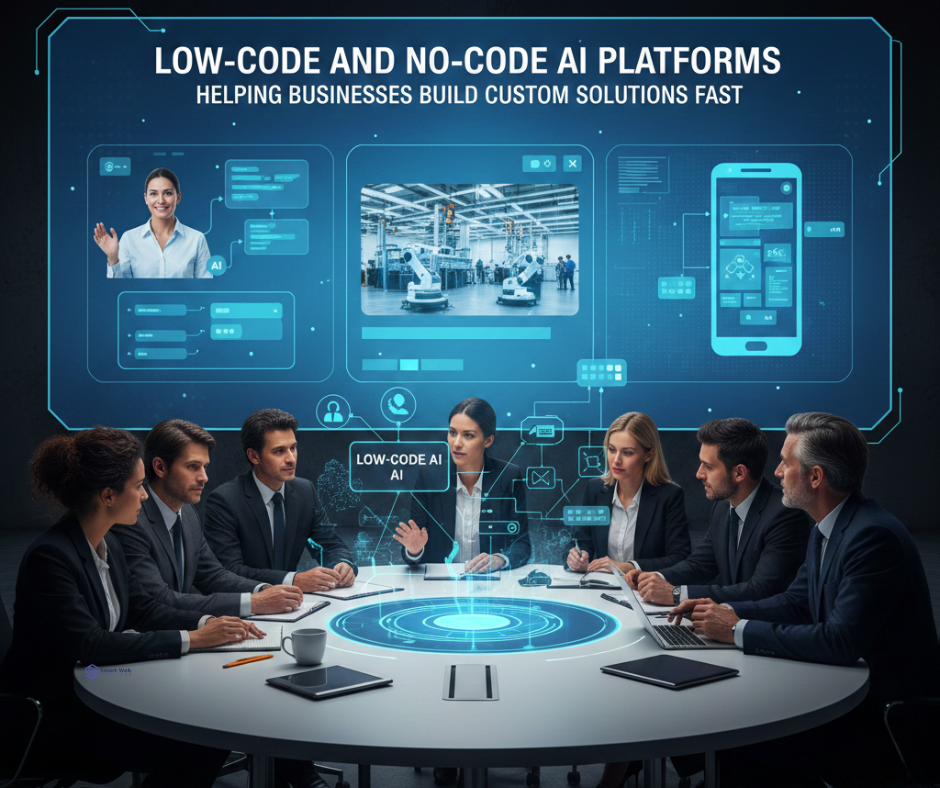
The pace of digital transformation has never been faster. Businesses today are under constant pressure to innovate, automate, and launch new digital solutions—often with limited budgets, tight timelines, and a shortage of skilled developers. This is where low-code and no-code AI platforms are transforming the game.
By enabling organizations to build powerful, AI-driven applications with minimal or no traditional coding, these platforms are helping businesses create custom solutions faster, smarter, and more affordably than ever before.
What Are Low-Code and No-Code AI Platforms?
Low-code and no-code platforms allow users to build applications using visual interfaces, drag-and-drop components, and pre-built templates.
- Low-code platforms require minimal coding and are often used by developers to accelerate development.
- No-code platforms require no programming knowledge and are designed for business users, marketers, and operations teams.
When combined with AI capabilities, these platforms enable businesses to build intelligent solutions such as:
- AI chatbots
- Workflow automation systems
- CRM and ERP tools
- Predictive analytics dashboards
- Customer support automation
- Recommendation engines
Why Businesses Are Adopting Low-Code & No-Code AI Solutions
Businesses across industries are embracing these platforms because they solve several major challenges at once.
1. Faster Time-to-Market
Traditional software development can take months—or even years. Low-code and no-code platforms reduce development time from months to days or weeks, giving businesses a competitive advantage.
2. Reduced Development Costs
Hiring full development teams is expensive. These platforms reduce dependency on large engineering teams, allowing companies to build and scale solutions at a fraction of the cost.
3. Empowering Non-Technical Teams
Marketing, HR, operations, and customer service teams can now build tools tailored to their needs without waiting for IT support.
4. Built-In AI Capabilities
Modern platforms integrate AI features such as:
- Natural language processing
- Machine learning models
- Automation engines
- Data analytics and forecasting
This allows businesses to create smart applications without AI expertise.
How AI Enhances Low-Code and No-Code Platforms
AI is what takes these platforms from simple app builders to enterprise-grade solution creators.
AI-Powered Automation
Automate repetitive tasks like data entry, approvals, notifications, and customer follow-ups.
Predictive Analytics
Use AI models to analyze trends, forecast demand, and predict customer behavior.
Intelligent Chatbots
Create AI chatbots for websites, customer support, HR onboarding, and appointment booking.
Smart Decision Support
AI-driven insights help managers make data-backed decisions faster.
Common Business Use Cases
Low-code and no-code AI platforms are being used across industries for:
Customer Relationship Management (CRM)
Custom CRMs with AI-powered lead scoring, customer insights, and automated follow-ups.
Workflow & Process Automation
Streamlining approvals, task assignments, reporting, and notifications.
Ecommerce Optimization
Product recommendations, inventory forecasting, customer segmentation, and automated marketing workflows.
HR & Recruitment
Resume screening, onboarding automation, performance tracking, and employee analytics.
Finance & Operations
Expense management, forecasting, compliance tracking, and reporting dashboards.
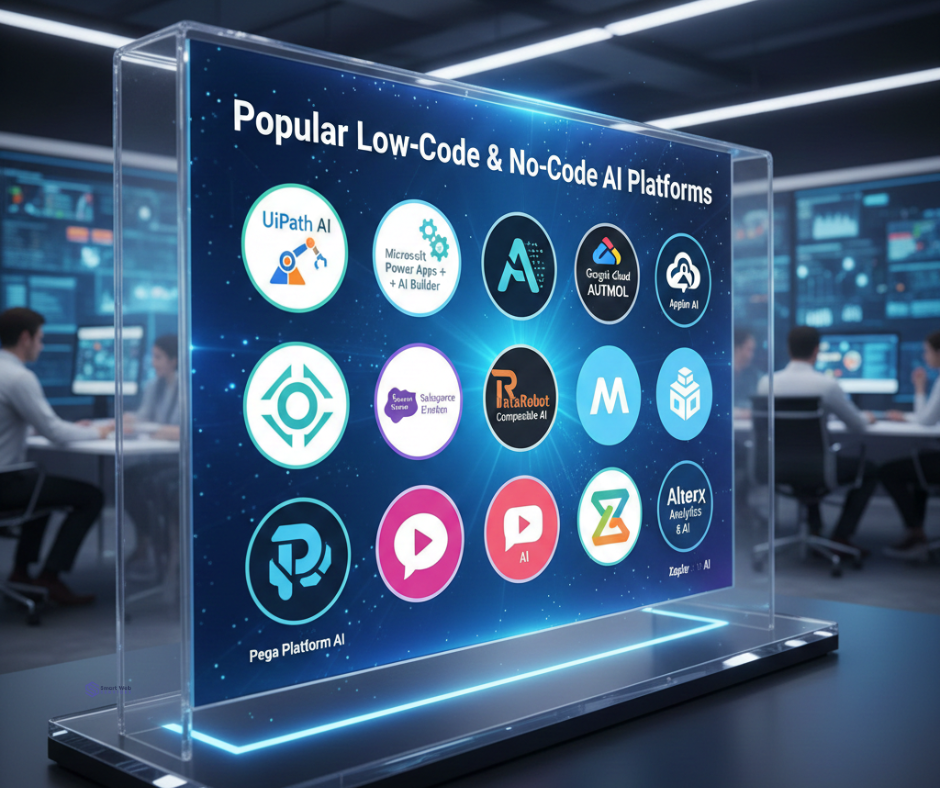
Popular Low-Code & No-Code AI Platforms
Some widely used platforms include:
- Microsoft Power Platform
- Bubble
- OutSystems
- Mendix
- Zapier
- AppSheet
- Retool
- Airtable with AI integrations
These platforms offer scalability, security, and enterprise-level integrations.
Benefits for Small, Medium, and Enterprise Businesses
For Small Businesses
- Launch digital tools quickly
- Reduce reliance on developers
- Compete with larger companies
For Medium Businesses
- Automate growing operations
- Improve efficiency without increasing headcount
- Build internal tools rapidly
For Enterprises
- Accelerate innovation
- Reduce IT backlogs
- Improve agility across departments
Security and Scalability Considerations
Modern low-code and no-code platforms are designed with enterprise-grade security in mind, including:
- Role-based access control
- Data encryption
- Compliance standards
- Secure cloud hosting
They also scale easily, allowing businesses to add features, users, and integrations as they grow.
Low-Code vs Traditional Development: A Quick Comparison
| Feature | Traditional Development | Low-Code / No-Code |
|---|---|---|
| Development Time | Months | Days / Weeks |
| Cost | High | Low |
| Technical Skills | Required | Minimal or None |
| Flexibility | Medium | High |
| AI Integration | Complex | Built-in |
Challenges to Be Aware Of
While powerful, these platforms are not a one-size-fits-all solution. Potential limitations include:
- Less control over highly complex custom logic
- Platform dependency
- Performance limits for very large-scale systems
For mission-critical or highly complex applications, a hybrid approach (low-code + custom development) often works best.
The Future of Business Development
Low-code and no-code AI platforms are not replacing developers—they are augmenting them. By removing repetitive work and accelerating delivery, they allow teams to focus on innovation rather than infrastructure.
As AI continues to evolve, these platforms will become even more intelligent, offering:
- Auto-generated workflows
- AI-assisted app design
- Predictive system optimization
- Self-healing automation
Businesses that adopt these tools early will move faster, adapt better, and stay ahead of competitors.

Final Thoughts
Low-code and no-code AI platforms are redefining how businesses build digital solutions. They empower teams, reduce costs, accelerate innovation, and unlock AI-driven capabilities without complexity.
For organizations looking to build custom solutions fast—without sacrificing quality—these platforms are no longer optional. They are the future of agile, intelligent business development.